![[V6360530W000] OM System POL-058 O-Ring for PT-058, PT-059](/web/image/product.template/29780/image_256)
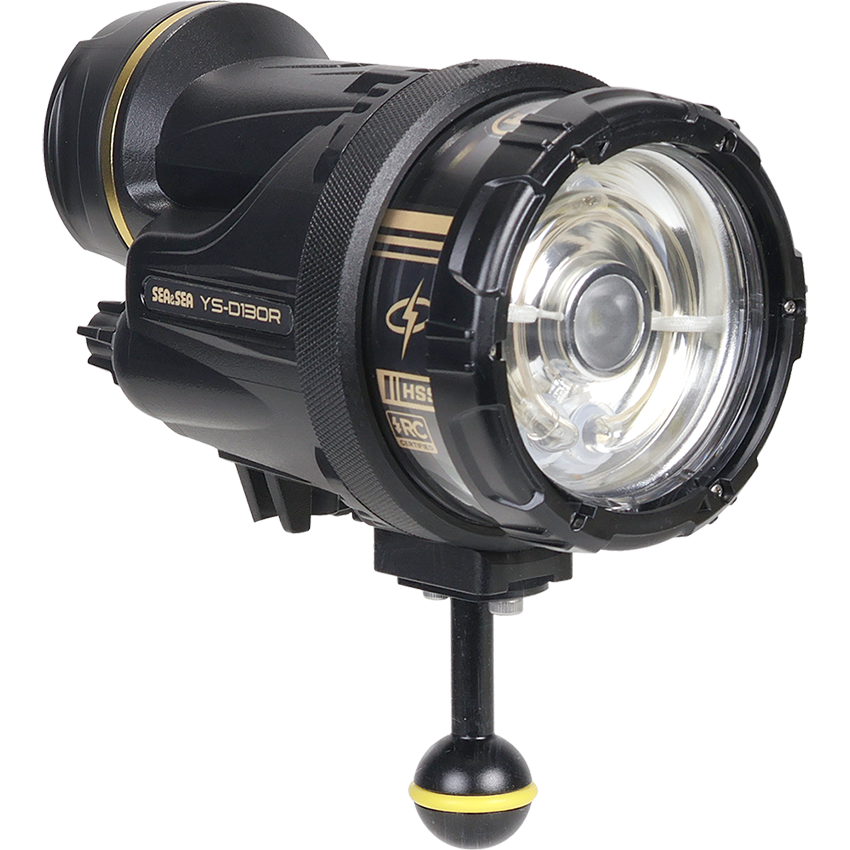
SEA&SEA YS-D130R Underwater Strobe System Pro Package
| Manufacturer: Sea&Sea |
Stock Code:
S&S-03133
Circular flash tube for even illumination
For the first time since the YS-250PRO, the YS-D130R features a newly designed circular flash tube combined with a dedicated reflector, delivering stable and uniform light output.
The smooth, evenly diffused circular beam illuminates your subject without harsh hotspots, producing soft, natural shadows and beautifully balanced lighting across the entire frame.
When shooting close to marine life, the circular catchlight appears naturally in the subject’s eyes, adding depth, expression, and a lively presence for stunning underwater portraits.
Natural and Soft Light
The YS-D130R is designed with a color temperature of 5600K, closely matching natural daylight.
Higher color temperatures produce cooler, bluish tones, while lower values create warmer, reddish hues—5600K delivers a perfectly balanced, natural look.
By applying an amber coating to the flash tube, the YS-D130R produces light that is both soft and natural, closely resembling sunlight underwater.
Additionally, while diffusers typically alter color temperature, the YS-D130R’s dedicated diffuser is specially engineered to maintain consistent color fidelity, ensuring stable and natural lighting in every shot.
RC Mode Officially Certified by OM Digital Solutions Corporation
The YS-D130R supports RC Mode of the OM SYSTEM Wireless RC Flash System by OM Digital Solutions. Flash output can be precisely controlled via digital light signals from the camera, enabling accurate exposure control. When paired with a compatible camera, this feature provides a more comfortable and seamless underwater shooting experience.
Intuitive Color LCD Display for Clear Visibility
The YS-D130R is equipped with a color LCD panel that clearly displays essential information such as battery level, strobe mode, and exposure compensation at a glance.
Icons and numeric indicators ensure excellent visibility even in dark underwater environments or during night dives. During shooting, the selected mode is always displayed, and each shooting mode is color-coded for instant recognition. All modes and settings are shown digitally, allowing smooth, intuitive customization to match your shooting style and camera system.

RC Mode

DS-TTL II mode

HSS Mode

Manual Mode
Dual Battery System for Maximum Flexibility
Since it can use both a high-energy dedicated lithium-ion battery pack (SB-L02) and versatile AA batteries (Ni-MH or alkaline), it offers highly flexible operation.
This innovative design offers exceptional flexibility, allowing you to adapt to different shooting environments and power availability. The SB-L02 enables high-speed recycling and supports high-speed continuous shooting. You’ll never miss a fleeting photo opportunity.
Supports High-Speed Sync (HSS) Shooting
What is High-Speed Sync (HSS)?
In DSLR and mirrorless cameras equipped with a focal-plane shutter, the standard flash synchronization speed is typically around 1/200 sec, even for high-end models.
A conventional strobe emits a single burst of light while the shutter is fully open.
At shutter speeds faster than the sync speed, part of the image would normally be blocked by the moving shutter curtains, resulting in a dark band across the frame.
With High-Speed Sync (HSS), the YS-D130R emits a rapid series of flashes while the shutter curtains travel across the sensor.
This enables perfect synchronization at high shutter speeds, providing even and consistent illumination across the entire image — even when shooting in bright environments or with wide apertures.
To use High-Speed Sync (HSS) shooting, the following conditions must be met:
- The camera must support HSS/FP flash.
- The communication system between the camera and strobe must also support HSS.
Please refer to the compatibility chart for details.
In OM SYSTEM RC Mode, FP flash operates as “TTL HSS.” In other systems, it functions as “Manual HSS.”
Benefits and Applications of HSS
- When shooting in bright daylight to create background blur
In shallow waters or bright environments—such as over white sand or when photographing light-colored subjects—you may want to open the aperture for a shallow depth of field to blur the background.
However, under strong sunlight, this often leads to overexposure even when using fast shutter speeds up to 1/200 sec, which is the typical sync limit for conventional strobes.
With the YS-D130R’s HSS mode, the strobe can synchronize even at 1/500 sec, 1/1000 sec, or faster, allowing proper exposure control and enabling you to achieve your desired creative look.
- Shooting Backlit Subjects from a Low Angle
When photographing subjects swimming in shallow or mid-water during daylight, shooting upward often results in strong backlighting. To avoid the subject appearing as a silhouette and to reproduce its natural colors, strobe lighting becomes essential.
Using a wide aperture to achieve a shallow depth of field can easily lead to overexposure. Even when increasing the shutter speed, conventional strobes are limited by a maximum sync speed of around 1/200 sec.
With the YS-D130R’s HSS mode, higher shutter speeds can be used for precise exposure control, allowing you to maintain a shallow depth of field while achieving correct exposure.
- Isolating the Subject Against a Black Background
In macro photography, isolating the subject by illuminating only it with strobe light is an effective way to make it stand out while letting the background fall into darkness.
With the YS-D130R’s HSS mode, high shutter speeds can be used even at wide apertures, allowing precise control of ambient light. This makes it possible to render blue backgrounds completely black while keeping the subject properly exposed.
When the background is the seabed or a wall, the Snoot 02 can be used to focus light precisely on the subject, further enhancing subject isolation and creating a clean black background.
- When freezing fast-moving subjects
HSS is also effective for capturing subjects in motion or in situations where camera shake or motion blur is likely to occur.
By using higher shutter speeds, you can freeze action clearly and capture sharp, dynamic underwater images.
All-New Battery Cap Design
A completely redesigned waterproof structure moves the sealing surface from the cap to the strobe body itself—minimizing the risk of water intrusion when opening or closing. The battery is now secured inside the strobe, preventing accidental drops during handling and making operation safer and more dependable in any diving environment.
DS-TTL II Mode
DS-TTL II is SEA&SEA’s advanced automatic exposure control system. It supports multiple tuning patterns to ensure compatibility with a wide range of camera systems, providing stable exposure and precise synchronization under various shooting conditions.
With DS-TTL II, simply connect the strobe to your digital SLR camera—no complicated setup is required. The flash output automatically follows the camera’s TTL control in real time, delivering natural, well-balanced lighting for every shot. The YS-D130R further enhances the accuracy of flash timing, achieving even greater stability and exposure precision compared to previous models.
Setting up is simple: just match the strobe’s flash mode to the channel of your camera and housing sync system. All settings are clearly displayed on the LCD panel for easy confirmation.
Available Mode Settings by Manufacturer:
- Canon: 6 types (A/B/C/D/E/F)
- Nikon: 5 types (A/B/C/D/E)
- Sony: 5 types (A/B/C/D/E)
- OM SYSTEM: 2 types (A/B)
- Panasonic: 2 types (A/B)
- SEA&SEA Cameras: 2 types (A/B)
- SEA&SEA Cameras: 2 types (A/B)
TTL Exposure Compensation Range: -3.0EV to +3.0EV
*Exposure compensation steps can be set to 0.3EV, 0.5EV, or 1.0EV in Setup Mode.
Rapid-fire capability
Never Miss the Perfect Moment – Continuous Shooting Performance
Continuous shooting is essential for capturing decisive moments in wildlife and behavioral photography.
However, with strobes that have long recycle times, the flash cannot keep up with the camera’s rapid shooting speed. With the YS-D130R—when using the dedicated lithium-ion battery pack—you can shoot continuously for 10 seconds at 5–10 frames per second (at -3 EV).
This high-speed recycle performance ensures you never miss that critical underwater moment.
Enhanced Target Light for Precise Illumination
The adoption of a circular flash tube allows the target light to be positioned perfectly at the center of the light axis, providing accurate and consistent illumination directly on the subject without any offset.
The included diffuser features a built-in red filter in the center, making it ideal for photographing light-sensitive marine life.
The target light’s brightness can be adjusted from 5% to 100%, enabling precise control to suit any shooting environment.
User Customization Features
The YS-D130R offers a wide range of customization options that allow users to fine-tune the strobe’s behavior according to their personal shooting style and environmental conditions.
Every aspect of operation can be tailored for maximum comfort and efficiency underwater.
Customizable settings include:
- Target light brightness steps: Selectable from 5%, 10%, 20%, 25%, or 50%.
- Beep sound: Can be turned ON or OFF.
- LCD orientation: Display can be inverted depending on strobe mounting position.
- Sleep mode: Selectable from OFF, 5, 10, 30, or 60 minutes.
- Auto power-off: Selectable from OFF, 5, 10, 30, or 60 minutes.
- Output/compensation step adjustment: For Manual, RC, TTL, and HSS modes, steps can be set to 0.3EV, 0.5EV, or 1.0EV
High-Speed Recycle Time
When equipped with the specially developed lithium-ion battery pack (SB-L02), the YS-D130R achieves an impressive recycle time of 0.8 seconds at full power and 0.2 seconds at half power (-1.0EV)—virtually eliminating waiting time between shots. You’ll never miss a critical moment, even during fast-paced shooting sequences.
The dedicated lithium-ion battery pack is included with the PRO Package and also available as a separate accessory.
Manual Mode
The YS-D130R offers two manual flash types to match different camera systems:
- MANUAL-P: With pre-flash cancellation
- MANUAL-N: Without pre-flash cancellation
Manual Light Intensity Setting: 1.0 to -9.0 EV
*Light intensity steps can be set to 0.3 EV, 0.5 EV, or 1.0 EV in Setup Mode.
Select the appropriate type according to your camera model to ensure proper synchronization and reliable flash performance.
Features a cold-resistant “Low Temperature Mode”
The “Low Temperature Mode” is included to ensure optimal operability regardless of environmental conditions.
In environments with low air or water temperatures, battery output may decrease, potentially causing power instability or inaccurate battery level displays. Enabling Low Temperature Mode ensures stable performance even during winter when water temperatures drop or in cold regions.
*Recommended operating environment: 15°C (59°F) or below.
*Battery consumption increases and recycling time extends while Low Temperature Mode is active.
Your Dynamic Snippet will be displayed here...
This message is displayed because youy did not provide both a filter and a template to use.
Product Accessories
1 items