
New to underwater photography?
We get a lot of customers new to underwater photography and they are typically one of two things: an experienced topside photographer branching into underwater, or an experienced diver wanting to get into photography.
The most common enquiries are about a package of gear for newbies. In our experience, the following points are the main considerations for getting the right gear:
- Affordability. This is different for each person. Figure out what this means for you personally, but also realistically; there is a degree to which you get what you pay for. Do you compromise on your gear to fit the budget, or your budget to get the right gear? How much you are willing to invest in your gear might actually depend on the next two points.
- Can it be adapted? If you decide to upgrade your camera, are there non-housing elements that can be used in a different housing system? It is important to consider the brands we have available, as some prefer their own ecosystem, while others are much more versatile and allow for third-party brands.
- Is it appropriate for you? Underwater photography takes a lot of time, trial and error, patience, and consideration. It is important to be realistic about your skill level as a diver as well as a photographer, as adding complications too quickly can lead to frustrations. If you start introducing additional technical gear, make sure you take your setup on test dives, as the last thing you want is to be on an exciting trip and your gear inhibits you!
Below are a variety of options that cover these three principals and are also our picks for the best places to start.
Divevolk SeaTouch
A revolutionary underwater smartphone housing that redefines accessibility and functionality beneath the waves. Unlike traditional button-type housings, the SeaTouch 4 Max Plus allows unrestricted access to all of your phone's functions via touchscreen, even at depths of up to 60 meters. Whether you are at the surface or deep underwater, you can seamlessly use all apps, ensuring that your smartphone's full potential is always at your fingertips.
This is the perfect place to start if you are just wanting to test the waters... so to speak. The housing can reach a maximum depth of 60m/190ft, so is easily ready for any diving or snorkelling adventure you have up your sleeve. All you need is your phone!
There is also the opportunity to add accessories such as colour filters, a wide angle lens, or dual handle tray which has the capability to have arms and strobes attached.
OM System Tough Cameras
Designed for adrenaline junkies who want to capture fast action under extreme conditions. Tough cameras are waterproof, shockproof, crushproof, freezeproof, and dustproof for worry-free operation on any adventure. They have the power to create incredibly crisp and bright shots, even in low-light environments (like underwater) or when you’re on the move (Tough records smooth 4K video too). Powerful modes like Underwater Snapshot, Underwater Macro, and Underwater HDR – which uses composite technology to enhance light and shadow – allow you to resurface with bright, vibrant images.
- Waterproof to depths of 50 feet (15 meters), perfect for snorkeling, battling the waves, or any wet adventures.
- Shockproof from a height of 7 feet (2.1 meters) and crushproof to withstand up to 220 pounds of force (100 kgf).
- Select OM SYSTEM cameras and lenses feature some of the industry’s best IP53 weathersealed construction for splashproof, dustproof, freezeproof (to 14°F / -10°C) performance.
If you want to take it even deeper, there are multiple housing kits to choose from.
Compact Camera Housings
Compact and point-and-shoot cameras are an excellent choice for anyone investing into their first underwater housing setup. With the immense popularity of compact cameras such as the Canon Powershot G7X III, Sony Cybershot RX100m, and the aforementioned OM System TG series, we have housings available to take them to brand new depths.
Point-n-shoots can also be more adaptable than MIL or DSLR cameras, as you're not locked into your lens/port. And if you stick to a camera brand that you've already used, chances are that camera operations will be similar, if not the same.
Smaller cameras do tend to be quiet heavy underwater as they have less space for air, so we would recommend using tube or foam arms to increase buoyancy during dives.
Most of these housings allow for the additional use of trays, handles, arms, and strobes.
DSLR/Mirrorless Housings
It's quite common for people to consider a housing for a camera they already own. Often this will be a DSLR that they've had for years, which has pros and cons.
The pro is that it's a system you understand well. The cons though, can often outweigh this. Getting a housing for a DSLR can get more expensive as ports and lenses are added, and the learning curve may be steeper than expected, as more complications are taken into consideration.
However, this is likely the setup you will have for the longest time and is often worth the investment.
Extras
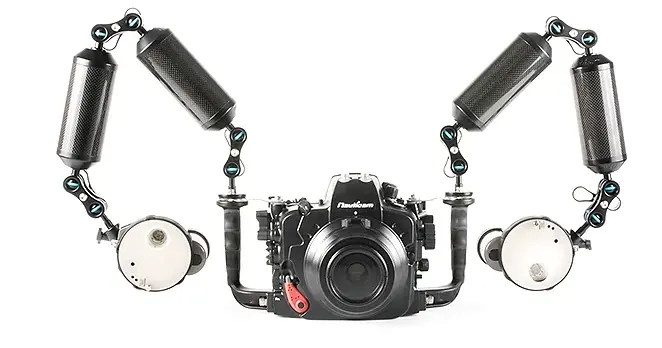
The main things to consider are arms, lenses and strobes. While they are extra costs and considerations, which may be overwhelming for a beginner, they are worth thinking about for the long term.
Arms are fairly simple to understand. There are a few types depending on your needs:
- Loc-Line is a modular, flexible plastic hose system in photography rigs to position lights and strobes.
- Tube or foam arms add buoyancy. Foam arms are adjustable and tube arms come in a variety of sizes.
- Double ball arms and clamps are more expensive, but they tend to be the industry standard. If you get serious, you will need the versatility and
You can buy cheap wet lenses and filters. Our advice, though, is to buy quality from the get-go, buy M64 screw fittings (assuming that fits your housing) and treat them well. They can last years. You won't regret it, we promise.
Strobes: Do you have to use a certain type of arm with your strobes? Do your strobes need TTL converters to use with a modern camera, or can you use fibre optic cords with them without converters? These extras can add up. (Was that last part total gibberish to you? That's okay, just talk to us, we can help out.)